Minority Issues
Forum Student Poster Presenters
INFORMS 2011,
Charlotte, NC
November 13,
2011
Special
Acknowledgement to the National Science Foundation (CMMI-1130507)
Integer Programming Techniques for Matroid Circuit Problems
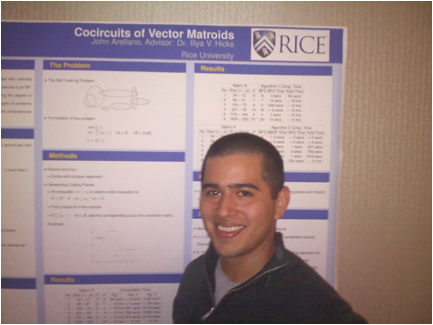
John Arellano
Computational
and Applied Mathematics
Rice University
Abstract
I present a set covering problem (SCP) formulation of the matroid
cogirth problem. Addressing the matroid cogirth problem can lead to
significantly enhancing the design process of sensor networks. The
solution to the matroid cogirth problem provides the degree of redundancy of
the corresponding sensor network, and allows for the evaluation of the quality
of the network. I provide computational results to validate a
branch-and-cut algorithm that addresses the SCP formulation.
Computational Study of Decomposition Algorithms for
Mean-Risk Stochastic Programs

Tanisha G. Cotton
Industrial and Systems Engineering
Texas A&M University
Abstract
To introduce risk into
stochastic programs, convexity preserving dispersion statistics such as
quantile-deviation and absolute semi-deviation can be used to represent
mean-risk objectives. In this poster presentation, we report on a computational
study of decomposition algorithms for stochastic linear programs using standard
instances from the literature.
Coxian 2-Phase Approximation and Analysis of a
Terminating Queueing System: A
Border Crossing Model
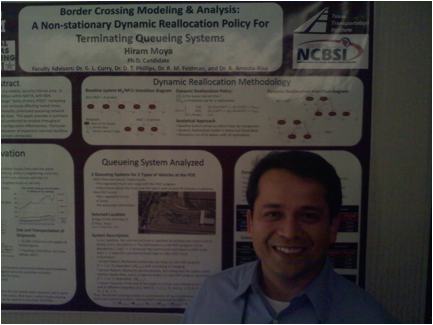
Hiram Moya
Industrial and Systems Engineering
Texas A&M University
Abstract
The U.S. international land boundary is a volatile, security intense
area. In 2009, the combined trade was $735 billion within NAFTA, with 80%
transported by commercial trucks through “ports of entry (POE)”. Increasing security
and inspection requirements are seriously affecting transit times. Each
POE is configured as a multi-commodity, prioritized queueing network which
rarely, if ever, operates in steady state. This paper provides a summary
of transient queueing network analysis conducted to analyze throughput rates,
queue lengths, cycle times and configuration effectiveness. Particular
emphasis is given to the dynamic reallocation of inspection (service)
facilities and inspectors under time-varying arrivals (demands).
Fluid Model of the Dynamics of
Patients and Physicians in Emergency Rooms
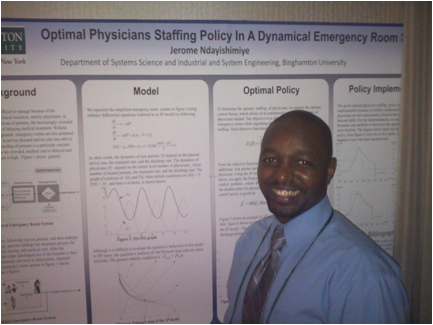
Jerome Ndayishimiye
Industrial and Systems Engineering
University of Buffalo
Abstract
Hospital emergency rooms are difficult to manage because of the complexity
of allocating costly resources, mainly physicians, in the light of the
dynamical arrivals of patients and the costs of delayed medical
treatment. We propose a fluid model using first order ordinary differential
equations to approximate the dynamics of patients and physicians in emergency
rooms. We then apply classical control theory mechanics to determine the
optimal control function to minimize patients’ holding costs and physicians’
utilization costs. Numerical solutions of our fluid model suggest a continuous
control function, which we discretize, using least square and mean value
methods, to approximate the best shifts staffing policy of physicians.
Skewness Variance Approximation
for Dynamic Rate Multi-Server Queues with Abandonment

Jamol J. Pender
Industrial and
Financial Engineering
Princeton
University
Abstract
A fundamental dynamic rate queueing model for large scale service
systems is a multi-server queue with non-homogeneous Poisson arrivals and
customer abandonment. By scaling the arrival rates and number of servers of
such systems, using the fluid and diffusion limit theorems found in Mandelbaum,
Massey, and Reiman (1998) we can approximate the stochastic behavior of this
queueing process by one that is Gaussian. Moreover, the approximations to the
mean and variance produced by these limiting processes form a two-dimensional
dynamical system. Recent work by Gautam and Ko (2011) found a modified version
of these differential equations and obtained better estimates of the mean and variance
for the original queueing system. We now introduce a new three-dimensional
dynamical system that surpasses these two approaches.
_______________________________________________________________________________________
Planning
Transportation of Disaster Relief Goods with Rural Recipients
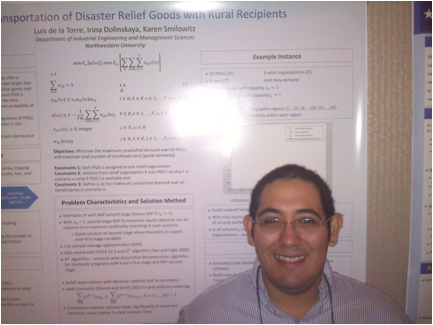
Luis de la
Torre
Industrial
Engineering and Management Sciences
Northwestern
University
Abstract
Disaster relief presents many
unique logistics challenges, with problems including damaged transportation
infrastructure, limited communication, and coordination of multiple agents. We
present ongoing work on the problem of distributing goods after a disaster to
many rural beneficiaries throughout the disaster-affected region. We model the
problem with two-stage stochastic programming with uncertainty in the
accessibility of beneficiaries and long-haul transportation to beneficiaries
planned before accessibility is known. We test our model using data from
simulated disaster settings, including earthquakes in the New Madrid fault
zone. We use sample average approximation and local search heuristics to find
high-quality solutions that consider fairness and equity to recipients along
with efficiency. This is joint work with Irina Dolinskaya and Karen Smilowitz.
Emergency Medical Service
Allocation in Response to Large Scale Events
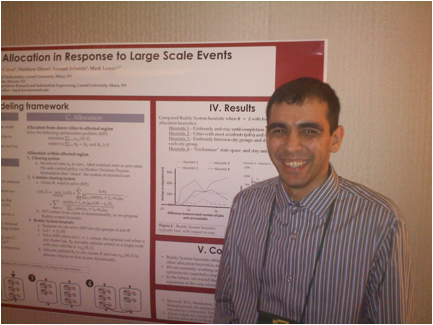
Gabriel Zayas-Caban
School of Operations Research and Information
Engineering
Cornell University
Abstract
In
the event of a catastrophic or large scale event demand for Emergency Medical
Service (EMS) vehicles in the affected region will almost certainly overwhelm
the available supply. In such cases, it is necessary for cities in the affected
region to request aid (in the form of added capacity) from neighboring
municipalities in order to bring the affected region back to its day-to-day
levels of operation. In this paper, we propose a systematic method to address
such scenarios.
In
particular, we consider a region consisting of several cities, where each city
is in charge of managing its own set of EMS vehicles. We propose that a
centralized or statewide decision-maker coordinate the temporary transfer of
resources (EMS vehicles) from cities in the unaffected region into the cities
in the affected region. We model
the control of each city's EMS vehicles as a multi-server queueing system and
use classical results to estimate the number of vehicles available at each
city. We then develop a knapsack
model to guide the allocation of available vehicles from the donor area into
the affected one and a clearing system model to dynamically control the added
resources.
As the
dimension of the problem is large, a heuristic we call the buddy system is
proposed where cities are paired to form city groups. This reduces the size of
the problem enough to solve the knapsack problem for initially allocating
vehicles to city groups. Within the city groups the clearing system model is
solved via Markov decision processes. The performance of our heuristic is
compared to several other reasonable heuristics via a detailed numerical study.
Results show that the buddy system exhibits significant cost and time savings,
and is generally robust to varying parameters.